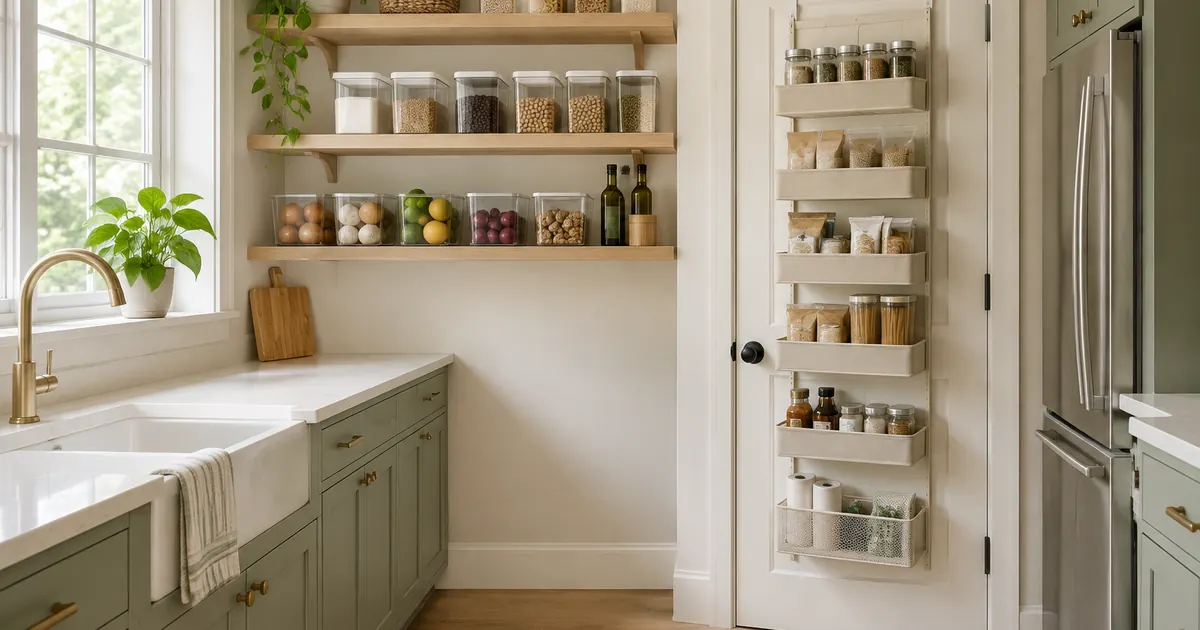
A small kitchen fails not because it lacks square footage, but because it uses only one plane — the counter. Look up, look at the doors, look inside the cabinets, and the same kitchen holds roughly twice as much. Here is where to find the hidden space, in order of payoff.
1. The Cabinet Interior You Are Wasting
Most base cabinets are 22–24 inches deep, but a single row of cleaning bottles uses the front 8 inches. An adjustable under-sink shelf rack instantly creates a second level around the disposal and plumbing, roughly doubling usable capacity in the single most awkward cabinet in the house. Measure around the P-trap first; the best racks adjust or shelf around it.
2. The Back of Every Door
A door is a 20-by-60-inch organizer waiting to happen. The pantry door handles snacks, foil, spices, and cleaning supplies; the basement or utility door handles paper goods. An over-door organizer with five fabric pockets installs in seconds, needs no hardware, and moves with you. The rule: flat, light items in pockets — never glass, never anything that leaks.
3. Walls: The Counter's Older Sibling
Two floating shelves above the counter add as much storage as a full cabinet — and in a small kitchen, open shelving visually expands the room. Style the wall with a mix: clear bins for everyday staples, a bamboo spice rack for the cooking zone, and one or two decor pieces so it reads as designed rather than stored. Keep the heaviest items low and the eye-level shelf for the pretty, frequently used pieces.
4. Stack, Don't Spread
Height is the cheapest storage commodity in any kitchen. Stackable fridge bins turn the fridge's chaotic middle shelf into labeled layers; canister sets stack where jars cannot. In cabinets, shelf risers double plate storage without a single screw. The pattern is consistent: any surface that holds one layer can hold two.
5. Decant the Bulk
Packaging is the silent space thief — half-empty boxes take the same shelf space as full ones but hold a third of the goods. Decanting into airtight containers with bamboo lids recovers that lost volume and, as a bonus, tells you the moment you are running low on anything.
A One-Weekend Plan
Friday: measure doors, cabinets, and one wall. Saturday: install the under-sink rack and over-door organizer, both tool-free. Sunday: decant the pantry staples and stack the fridge bins. By Sunday evening the kitchen works in the same footprint — just twice the kitchen.
The Fridge, Reconsidered
The fridge is a small kitchen's prime real estate, and most of us farm it like a parking lot. Three upgrades, zero tools: first, stackable clear bins create labeled layers — "Produce", "Proteins", "Leftovers" — so the middle shelf stops being a lottery. Second, a lazy susan corrals small jars and condiments; one spin replaces the great bottle dig. Third, the door rules: sauces and anything shelf-stable inside, never milk or eggs, which want the cold middle. A set of four stackable bins typically pays for itself the first week in rescued produce that stopped hiding.
Cabinet Doors: Inside Counts Too
Interior cabinet doors are the most overlooked mounting surface in any kitchen. Adhesive hooks inside a cabinet door hold measuring cups, oven mitts, or pot lids; a small over-the-cabinet basket takes sponges and brushes off the counter. The same logic as the pantry door organizer, scaled down — and it all disappears when the cabinet closes.
Counter Rules for Small Kitchens
In a small kitchen the counter is workspace, not storage — every square foot of clear counter makes cooking faster and the room calmer. The rule: only daily-use items live out, and each must earn its footprint. The coffee setup stays; the appliance graveyard goes into the cabinet you just organized. One styled moment — a plant, a cutting board leaned against the backsplash — keeps the room from feeling clinical. If the counter is currently full, the five-minute test tells you what stays: clear everything, and only what you reach for within 24 hours earns its way back.
Renters: All of This Works Without Drilling
Nothing in this guide requires a drill or a deposit loss. Over-door organizers hook on and move out; under-sink racks adjust and sit; stackable bins stack; tension shelf risers press into place; adhesive hooks rated for two pounds hold measuring cups for years and release clean with a hair-dryer's warmth. Small kitchens and rentals are the same problem with the same answer: claim the vertical space that already exists, and take it with you when you go.
Ready to organize?
Every piece mentioned ships free in the USA — and it's tax free.
Shop Kitchen Storage Shop Organizers